Първия официален стандарт на породата от 1909 година ... на английски е, ще го преведа, ако може някой да помогте, ще се радвам !
First official standard / Eerste officiële standaard
Reprinted from
"The Queen," The Lady's Newspaper
May 15, 1909
The following summary, compiled by Mr Kilburn Scott, may be found usefull by admirers of the breed.
It is now published for the first time:
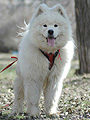
Colour: Pure white; white, with slight lemon markings; brown and white; black and white. The pure white dog come from the farthest north, and are most typical of the breed.
Exp
ression: Thoughtful, and remarkably pretty in face; fighting instincts strongly pronounced when roused.
Intelligence: Unusual intelligence as shown by the many purposes for which dogs are used by the Samoyed people and ease with which they can be taught tricks.
Size and weight: Dogs 19 to 21½ inches at shoulders; bitches 18 to 19½ inches at shoulders; weight about 40lb.
Head: Powerful-looking head, wedge-shaped, but not foxy. Wide and flat between ears, gradually tapering to eyes; stop not too pronounced; absolutely clean muzzle, not too long, with no lippiness; strong jaws and level teeth. The nose may be either black or flesh coloured.
Eyes: Very expressive and human like, sparkling when exited; set oblique and well apart. Eyes should be dark for preference, but other colours are admissible.
Ears: Pricked, set wide apart, and freely movable; set slightly back in contradistinction to the ears of the Esquimaux and chow-chow, which are forward; shape triangular and not too large; tip slightly rounded.
Body: Body shapely, but not cobby, with staight back; muscular, with deep ribs; chest wide and deep, showing great lung power; straight front and strong neck.
Legs: Good bone, muscular and not too long; thights well feathered; fore legs straight; hind legs sinewy and set for speed.
Feet: Long and slightly spread out to get good grip; toes arched and well together; soles hairy and well padded to give grip and protection from ice and snow.
Brush: Long, with profuse spreading hair; carried over back or side when on the alert or showing pleasure; when at rest dropped down, with slightly upward turn at end.
Coat: Long and thick, standing well out all over the body, especially along back; free from curl; undercoat very soft and woolly; large bristling ruff; hair on head and ears short and very smooth.
The Queen has long been an admirer of the breed, and Jacko, an imported dog, was certainly one of the best yet seen in England; while the King's Luska, though rather bigger than most of the Samoyedes, had many admirers. Amongst those who have had Samoyede puppies from Mrs Kilburn Scott's kennels are Her Majesty the Queen, Lady Burghclere, Lady Tichborne, Lady Dundas, Hon. Sidney Buxton, MP, Postmaster General, Mrs Hwfa Williams, Lady Russel, Sir Ernest Cassel, Princess Montylyon, the Hon. Mrs McLaren Morrison, Lady Sitwel, the Hon. Lilian Baring and Mrs Everitt Everitt.
Many will tell the inquirers after knowledge how extremely interesting and beautiful are Samoyede puppies. They have been well discribed as "Teddy Bears," and they are certainly much like one of the most popular toys ever introduced. As they grow older they lose none of their charming characteristics, and a question put to Mrs Kilburn Scott as to whether or not the dogs are save with little children was answered as follows: "I can assure you they are. We have always found our dogs the best of friends with our children, and they enjoy romping together. One of their favourite games is 'hunt the slipper,' and it is most amusing to watch the dogs seek the slipper and run off with it."
A great point in their favour is almost entire freedom from disease, and they do not appear to be subject to distemper as are other dogs. Believing that a good outcross would greatly benefit the breed in England, Mr Kilburn Scott has lately imported from Australia a magnificent dog wich formed one of the pack used by the explorer Borchevnik.
He was born on the Southern Cross on her way to the Antarctic, and he was only just been released from quarantine, but he is now with the other inmates of the Vale House kennel at Bromley. He stands 21½ inches high at the shoulder and is 35 inches long. He has a fine open forehead, great ruff on neck, spreading tail and hair round the toes which are so characteristic of the breed. His fur is snowy white all over, with the gloss on the hair which is peculiar to the breed. He is a most lovable dog, and, before being brought to England, he was shown to Jack London, who has written so charmingly on Arctic dogs and their character.
He declared Antarctic Buck - as the dog is called - to be one of the finest Arctic dogs he had ever seen. So typical a Samoyede should be a great accession to the breed, especially as an outcross had become absolutely necessary.


 Вход
Вход Регистрация
 Помощ
Помощ




 Горе
Горе Цитиране +





